Pages

10.26.2011

Be Italian - Day Seven

We made it to Ravenna in one piece, after a cramped ride on the local train (imagine riding the Metra with 2 suitcases and a range of carry on baggage.) The hotel, the Albergo Capello, is quaint, probably my favorite of the trip so far, and has a nice, spacious bathroom. We had a very tasty lunch in the hotel restaurant (usually I avoid them for being crappy and overpriced, but this one was neither, in fact, it has an honorable mention in the Michelin guide, supposedly). I had a rabbit ragu on handmade bowtie pasta that was excellent.

San Vitale, in Ravenna, on another dreary day.
After eating, we went to see San Vitale and the Mausoleo of Galla Placida (intended to be the burial site of a Roman emperor's wife, though it was never ultimately used that way.) San Vitale is sort of the star destination of the trip for me; it is the church that launched a thousand copycats. The mosaics, as predicted, were incredible. It's hard to fathom how something 1550 years old can still exist in such good condition. I can only conclude it must have been restored in recent years, as the colors are fantastically bright. 

SO beautiful!
Also notable is that San Vitale has two very famous mosaics of Justinian and Theodora, emperor and empress of the Eastern Roman Empire during the 6th century,  with their entourages. I've been learning about them since World History to 1500 my freshman year of high school, and it was amazing to see those pieces with my own eyes. They were so much brighter in person!

Justinian himself. This mosaic is actually the image Wikipedia uses to represent him.
The mausoleum was surprisingly impressive as well, with nearly the entire ceiling covered in flowers on a deep blue background, reminiscent of the night sky. I think when Dad saw it, he was suitably impressed, perhaps even enough to stop questioning my decision to come here.

The mausoleum contains this image of St. Lawrence, who was grilled to death.
Since it was nearby and we have plenty of time in Ravenna, we stopped at the Museo Nazionale to see a number of Bronze age, Roman, and later artifacts dug up in digs around the city, which came to prominence under Augustus Caesar, who built a port and naval base here. Dad was interested in statues and armor; I cared more about pottery fragments and household objects, which is hardly surprising.

Mosaic tesserae for sale.

It was nearing 4:30, when the major sites in town close, so we headed back to the hotel, stopping briefly at an open mosaic workshop/store where you can watch artists at work, buy their wares, and take classes yourself. The city is also currently hosting an international mosaic expo (they bill themselves as "the city of mosaics," so we ducked out of the endless drizzle of the past couple days  and into a church that was housing an exhibit of contemporary mosaic works. There were some interesting pieces, and I would say the predominant trend was toward playing with surface texture and moving into a three dimensional space.

Back at the hotel, we rested and worked on our respective writing duties before having a somewhat lackluster dinner selected on the basis of proximity to our hotel. I find it's usually worth the extra walk to find a good place, but Ravenna is a much smaller city than the ones we've been in the past few days, and the options were more limited. Still, the small-town atmosphere, predominantly pedestrianized streets, and smaller amounts of tourists are making for a very pleasant stay here...

10.25.2011

Be Italian - Day Six

Before we left Florence, we made one last stop at the Piazzele Michelangelo, a large square on a hill across the Arno from the city center. Dad was keen to see it because it combines two things he can't resist: a scenic panorama and the work of Michelangelo (it is decorated with copies of his famous works.) Since it was fairly remote, and seemed populated by a great number of tour buses and no taxis, he had ours wait for us while we looked around. It was indeed an epic overview of Florence, marred only by the fact that it was overcast, misty, and threatening to rain.

We had to ask three different people to take our picture to get one decent one.
Our second of four train journeys passed very briefly (35 minutes) and without incident, though again, the scenery left something to be desired -- we were in tunnels virtually the entire time.

By the time we got to Bologna, it was starting to rain, and as we were trying to enter the hotel, Dad was accosted by a garishly-dressed woman with a baby strapped to her chest, demanding money (no doubt a gypsy). She kept bumping into him (a distraction attempt) and he couldn't push her out of the way due to the baby. Soon, her hand was in his pocket, but he grabbed it before she could extract anything. Not exactly an auspicious start to our stay!

After checking in to our hotel, we commenced our walking tour of the town, starting with a nice lunch at a spot recommended by the concierge as a sentimental favorite of hers because her fiance took her there on their first date. I was sold; even if it made me miss Justin all the more. Bologna is something of a gastronomic hub in Italy, as it is home to both bolognese sauce, always served on tagliatelli here, and mortadella di Bologna, from which we derive bologna. The meal was pretty
tasty, but I decided to save my bolognese sauce experience for dinner.

Our afternoon walk took us through nearly all the sites of the historic city center, and though I was initially reluctant to try cramming the city into our itinerary, if we had to be anywhere on such a rainy, chilly, miserable day, I'm glad it was here. As it turns out, just about every building downtown has a portico, so you never really have to be exposed to the elements unless you're in a piazza or crossing the street.

Gotta love a portico on a rainy day!

The guidebook was short on details about the city, so we identified about five key sites for the afternoon, and popped into a couple random churches along the way.

From the fountain of Neptune in the Piazza Maggiore.
First was the Piazza Maggiore, home to a medieval palace, a notable fountain of Neptune festooned with women shooting water out of their breasts, and the town's cathedral, San Petronio, which is built of brick. The outside is fairly spartan (all the scaffolding for the restoration probably didn't help that impression), but the red brick on the inside was quite visually striking, especially against the off-white plaster. Interestingly, it was originally supposed to be bigger than St. Peter's, but they wasted so much money that the Church but the kibosh on their building funds, and as a result, the building isn't quite symmetrical. Supposedly, tales of all the money that they wasted were instrumental in turning Martin Luther against Catholicism.

More covert photo action in Bologna.
From there, we walked through the porticoed streets, past some very fancy shopping (the Bolognese must do pretty well for themselves to support a Gucci, Hermes, and Louis Vuitton on a single block), to, ironically enough, the world's first Dominican church, San Domenico. (The Dominican order adheres to a vow of poverty). Built after the founder of the order's death in the mid-1200's, they buried him there in a spectacularly ornate sarcophagus, complete with, you guessed it, some statues by Michelangelo. Dad was ecstatic once more.

The tomb of San Domenico. Two of the medium-sized sculptures in the middle are by Michelangelo.
Having done something for Dad, we went over to the Abbazia di Santo Stephano to appease me. This unusual structure is made up of several ancient and medieval churches built so close to one another that eventually they were all roofed over as one and combined. There was some very lovely decorative brickwork there, and some great grotesques of nude women in a cloister garden. They had also had three saints entombed there as well, in surprisingly modest digs compared to San Domenico. So much for that vow of theirs, I suppose.

I guess my love of gargoyles bleeds over into other building decorations as well.

Dad was fading fast, but I coaxed a few more blocks out of him to see the Torri degli Asinelli e Garisenda, two remnants of the hundreds of medieval towers attached to the homes of the wealthy that once comprised the Bologna skyline. They were tall indeed, and one had a considerable lean going on, while the other is considered the 4th tallest tower in Italy. Needless to say, we didn't climb it.

Mmm...
Having scratched the final item from our day's list, we headed back to the hotel for the customary evening rest period, followed by a real bowl of tagliatelli alla bolognese. Dad was not a fan -- he prefers to eat pasta with his sauce, and the texture of the real deal wasn't sufficiently wet for him, but I enjoyed the complex flavors and the textbook-perfect texture of the pasta. I have to give it to Dad; I think he was wise to include Bologna in our itinerary, despite my objections.

10.24.2011

Be Italian - Day Five

Our last full day in Florence wasn't quite as hectic, since we fit in so much yesterday. This was partly intentional on my part -- Dad wanted to leave for Bologna today, but I didn't want our only afternoon/evening there to be a Monday because many cultural institutions and points of tourist interest in Italy are closed on Mondays. I felt it was better to pass such a day in a place where we had less left to see.

We started slightly less early than yesterday, with tickets to see the Capelle Medici, or Medici chapels, at the church of San Lorenzo. The main portion was under restoration (par for the course given our track record of European travel, but it wasn't a huge loss, since San Lorenzo is the only part of Florence that I actually remember seeing when I was here 14 years ago.) I had to sneak pictures there, and a few other places today, as a "No Photos" sign was in place virtually everywhere we went today. I was starting to get pretty pissed with the Italian government by the end of the day -- I want my photos, damn it!

The main point of seeing the Capelle Medici, besides paying one's respects to their remains, is the quartet of Michelangelo sculptures that adorn a couple of them. They represent the four phases of a day: Dawn, Day, Dusk, and Night, which is supposed to be symbolic of the human lifespan. I liked the symbolism in them, but I think the quality of carving is better in either the David, or the Vatican Pieta. The latter is still my favorite work of his, though I can't decide if that's because I was younger and less jaded when I first saw it.

The figures of Night and Dusk from the tomb of Giuliano de' Medici.
As it turns out, the main part of San Lorenzo isn't open till 10, and Dad didn't want to wait a half hour for it, so we progressed through an open air market where I found a couple cheap scarves to bring home as souvenirs, towards the Mercato Centrale, the biggest food market in Florence. They did indeed have a formidable array of food products, beautifully displayed, and somewhat embarrassingly, I think I took more pictures there than anywhere else so far. (In my defense, there was no photography ban there!) 

Items for sale at the Mercato Centrale. Note the multiple packages of penis-shaped pasta they're trying to sell to tourists. People must buy it, if there's so much for sale, right?

Once I concluded Dad couldn't handle any more food voyeurism, we walked over to Santa Maria Novella, a large church with a beautiful facade, near the central train station. This church was also behind a pay wall, and had a no photography policy that I only partially heeded. It makes me apoplectic to have to pay to get in, and not be allowed to take photos!

Tripod photo!
Santa Maria Novella had some truly spectacular 14th and 15th century frescoes behind the altar and in the front chapels, though the nave of the church was surprisingly bare.

Take that, Italian Ministry of Cultural Heritage!
I kind of wanted to take our morning purchases back to the hotel so we wouldn't have to haul them around all day, but since we were close to the Duomo, Dad wanted to press on. Once we were in the city center, we checked out the bronze and gilt doors of the baptistery by Lorenzo Ghiberti before queuing up to enter the main cathedral.
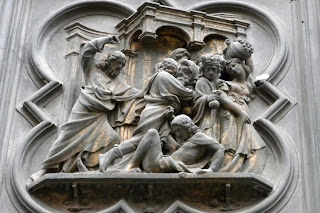
Jesus casting the moneychangers out of the temple, on the north side of the baptistery.
For 14 years, it has haunted me that the student tour of Florence I went on as a preteen only included the outside of the church, but after seeing it today, I think they may have been on to something when they cut it from the itinerary -- almost all of the ornament is on the outside of the building! It was seriously one of the plainest church interiors I've seen in Europe. Aside from a Vasari painting of the Last Judgment on the inside of the Brunelleschi-designed dome, there was little to see there. We opted to skip climbing to the top of the dome or bell tower, despite the promise of iconic panoramas, especially due to the presence of a fleet of ambulances parked next to the bell tower; not exactly a reassuring slight when you're contemplating a multi-story climb...

The Duomo is so huge, it's impossible to stand anywhere near it and get the whole thing in one picture.
By then, Dad was starving, so it was time to track down one of Stephanie's picks for lunch, Ristorante al Teatro. We only had to walk about two blocks out of our way to find it, and it was worth the modestly inconvenient walk: I had a pizza with spicy salami, while Dad had roast pork, after I imposed a moratorium on him eating pasta with meat sauce after he had it three times in the past two days.

After filling up, we did a bit more shopping before locating the Orsanmichele, one of Stephanie's favorite buildings in the city. It is an interesting structure; built in the 1330s as a grain market and storage center, the bottom was later turned into a church, which still exists, though, again, no photos allowed (though I snuck one of the beautiful altar.) Since it was Monday, I gleaned from Steph's ever-helpful notes, the upper floors of the building are open to the public (for whatever reason, it's only open on Mondays, in a reversal of the usual Italian policy), so we went up to see the original statues from Donatello and others that once graced the building's facade (copies are now in their place.)

Statues of the saints inside the Orsanmichele. My favorite was the one in the center of this grouping, which depicts the Incredulity of Thomas.
Our last stop for the day was the Museo dell' Opera del Duomo, (opera, we've deduced, means something like workshop in Italian), where most of the great works of art from the Duomo have been inexplicably moved. I can understand removing things from the facade and replacing them with  less valuable replicas, but not really the stuff from inside, unless their conservation needs were difficult, which most of these didn't seem to be.

Michelangelo on the left, Donatello on the right.

There, Dad was regaled by one last Michelangelo for the trip, the Bandini Pieta, which was intended for his own tomb (clearly, they didn't respect his wishes on that one), though I was much more captivated by Donatello's wooden statue of Mary Magdalene. It was a little Gothic, terrifically expressive, and almost foreshadows the later Impressionist sculpture style developed by Rodin. Dad was also interested in a number of architectural displays that explained the construction of the church, and how Brunelleschi had to deduce lost Roman building techniques to bring his design to fruition.

To see the entire Duomo, you have to get above the roof line. Here is the view from the Orsanmichele.
By the end of the visit, I knew I would be hard-pressed to convince Dad to go anywhere else, so it was back to the hotel for another pre-dinner rest before enjoying a lovely dinner with very friendly service at Quattro Leone, yet another restaurant gleaned from Stephanie's reservations. Thanks to her, we've eaten very well in Florence. It pays to have friends in the know!

10.23.2011

Be Italian - Day Four

To say that our second day in Florence was jam-packed is somewhat of an understatement -- we saw so many artistic masterpieces today that I can scarcely remember them all!

We made a very, very early start to the day, with tickets to the Galleria dell' Accademia for 8:15 in the morning. Dad wanted to do our best to avoid the hordes of tour groups, though they magically materialized, all at the same time, at 8:14. We were first in line for the non-group reserved ticket line, and once we made it in, Dad made a beeline straight for the David, completely ignoring the rooms of art preceding it. He was clearly a man on a mission.

The piece for which we made this entire journey was indeed, quite impressive in scale, though I was quick to point out that parts of it were not in proportion, like his left ankle which was swollen-looking, perhaps to help bear the weight of the statue, and the over-size hands. Dad, however, was ecstatic as a religious pilgrim, especially because his mad dash there made for a virtual private viewing, while the tour groups caught up with us.

More adventures in illicit photography, which explains the strange angle on this one.
The Accademia contained a few other works by Michelangelo, such as a few of his unfinished captive slaves, but overall, the collection wasn't large and we were done by 9:00. With our new-found bonus time (I thought the Accademia would take longer, so I didn't book entry tickets to the Uffizi until 1:30), I decided to steer us towards the Bargello, Stephanie's favorite museum, which I justified to Dad with their additional Michelangelo works, which would fall in line with his need to leave no stone unturned in that regard. I, however, wanted to see Donatello's David, and some of the pieces submitted to the contest to decorate the baptistery doors of the Duomo, considered to be the inaugural works of the Renaissance.

Apparently the Bargello used to be a prison, but it doesn't look so bad to me...
Without a doubt, the Bargello possessed a more balanced collection than the Accademia, but Dad would probably not agree with that assessment. There were also some particularly nice works by Cellini there, who I hadn't really heard of before today, and I always appreciate when a museum can introduce me to something new. 

In the Palazzo Vecchio.
Since we were, by this point, in the city center, we strolled over to the Palazzo Vecchio, formerly a palace of the Medici before they moved to grander digs on the outskirts of town, then a sort of city hall. I had to tempt Dad inside with the promise of yet another Michelangelo (this time a statue of Victory), even though he usually can't resist a heavily embellished palace. The Michelangelo wasn't very impressive, I thought, though it was hard to properly appreciate it because they were having some sort of choir performance in the same room, and the area with the sculpture was partially roped off.  More interesting, I thought, was a sculpture of Hercules fighting King Diomedes by de Rossi, in which the King literally has the hero by the balls. You don't tend to see a lot of junk-grabbing in art, especially from that era.

Diomedes fights dirty, apparently.
With just enough time to eat, we grabbed a rather lackluster pizza lunch in the same piazza as the Palazzo Vecchio and the Uffizi; it was a very touristy place, but we didn't have time to walk in search of something more palatable.

"Perseus with the Head of Medusa," by Cellini, in the Piazza della Signoria, next to the Palazzo Vecchio. Always a fan of the macabre in art, I appreciate the unique approach to dripping blood seen here.
The afternoon was dedicated to the Uffizi, considered to be the greatest art museum in Italy, and one of the greatest in the world at large. Their list of famous works is truly enviable: Botticelli's "Birth of Venus," Michelangelo's "Doni Tondi" (a round painting of the Holy Family, but hey, at least it was a painting, not another sculpture,) Titian's controversial "Venus of Urbino," and another one of my favorite paintings, Parmigiano's "Madonna of the Long Neck." I kind of love Italian Mannerist painting -- everyone looks like a vaguely creepy alien. Not surprisingly, this one wasn't on a postcard in the gift shop, though it was the only one I was interested in buying.

Time to get our museum on!
My only problem with the Uffizi was that they only have one bathroom for the whole place, and it at the very end of the visit, after the gift shop. They'd probably sell more stuff if visitors weren't rushing through it to empty their bladders. And, just my luck, half the toilets were closed for repairs, so the line was a mile long. I waited 5 minutes and gave up.

By this point, Dad was getting pretty cranky over all the walking and museum going I'd made him do today (we had to cram them all in today because Italian museums are closed on Mondays), but I managed to get him to cross the historic, though somewhat over-hyped Ponte Vecchio with me, since we were right by it. He charged across it with purpose, straight to the taxi stand on the other side, and we came back to the hotel for an (admittedly, much deserved) afternoon rest.

The upper portion (in beige) was added later so that the Medici could cross the bridge without having to mingle with the common folks down on the main level.
Dinner tonight was another one of Steph's recommendations: Osteria Santo Spirito, which I picked off her comprehensive list due to her assertion that their gnocchi is so good that she has dreams about it. Given that gnocchi straddle the line between potato products and dumplings (two things I love very dearly), they are one of my favorite Italian foods, so I felt I needed to try these. They did not disappoint. They were pillowy soft, without so much of a hint of the doughy chewiness seen in gnocchi on this side of the pond, and floating in a cheesy, truffle oil-scented sauce. Last night's meal is still my favorite, but this was a close contender. Thanks Steph!

Maybe not dream-inducing, but still damn tasty.

10.22.2011

Be Italian - Day Three

We made it to Florence in one piece earlier this afternoon, after a two hour train ride. Unlike some of our European train travels, this one was not particularly scenic. My only observation for the trip? I can't tell if they indeed only grow cypress trees in Italy, or if they just landscape all the other trees to look like them.

Santa Croce, in Florence, where this building style seems fairly popular.
Once in town, we walked 10 or so minutes over to the church of Santa Croce, where Michelangelo is buried, along with Galileo (who was moved to his current spot a hundred years after his death, when the church finally acknowledged that he was right about the whole heliocentrism thing) and Machiavelli.

Here rests Michelangelo, beneath none of the sculptures he had started as adornments for his own tomb.
We had to pay an entrance fee to see the church, which always bugs me, and then the frescoed altar was under renovation, so we couldn't see it. The tombs were interesting, and Dad was glad to pay his respects to his hero. I was most impressed with how bright it was in there. I practically needed sunglasses indoors, and that rarely happens in European churches.

The cloisters of Santa Croce.
Santa Croce also had an elaborate series of cloister gardens and associated chapels, which were pretty enough, but they contained no famous masterpieces. Sadly, the entire facility was flooded under 15 ft of water, mud, and oil from the nearby Arno River in 1966, requiring a vigorous restoration of basically everything in the church at the time.

As it turns out, Micelangelo is buried at Santa Croce because his family home is about a block away. Though it wasn't in the guidebook, Dad, who seems to have an eagle eye for all things Michelangelo, spotted it on the map and insisted we go. It was kind of lame, I thought, though they did have two pieces he completed as a teen -- the "Madonna of the Stairs," supposedly demonstrating the influence of Donatello on his work, and the "Battle of the Centaurs", showing his interest in Classical works. I thought the Madonna was more interesting; it was a surprisingly down-to-earth image of Mary breastfeeding the infant Christ, not the usual regal depiction of her.

Dad, in front of Michelangelo's family home, which is fairly nondescript.
They also had a couple of his sketches, very rare in the art world, as the artist burned most of his drawings because of his perfectionistic streak. He didn't want people to see that he had to experiment and try different things to get things right. It certainly seemed like the family did pretty well for themselves living off his legacy -- many of the rooms were pretty swank, including one done in painted panels to commemorate scenes from Michelangelo's life that was just slightly over-the-top.

It was getting close to 5, when everything closes for the day (despite the 2-3 hours most places are closed for lunch)n so we walked back to the hotel, pausing quickly at a small church dedicated to St. Ambrogio to see some 14th century frescoes on a whim. It's amazing the things that are just quietly lurking in all these centuries-old buildings! You never know what you'll find if you just stop and investigate.

For dinner, we relied on an impressive list of recommendations given to me by my friend Stephanie, who lived in Florence as a grad student getting her master's degree. (Now she's at Wash U, my alma mater, getting her PhD in art history, because she is awesome.) We opted for La Giostra, a restaurant in a historic building (is there any other kind in Florence?), run by some Hapsburg-Lorraine princes. There, I had what I would come to consider the best meal of the entire trip, a plate of tortelloni stuffed with burrata cheese (one of my absolute favorites, though it's very difficult to find in the U.S., served in a cream sauce and topped with shaved white truffles. Fall is truffle season in Italy, and they've been prominently featured on menus everywhere we've gone so far. I wouldn't be surprised if the smell of them starts oozing out of my pores soon, but it will be so, so worth it!

10.21.2011

Be Italian - Day Two

True to our classic vacation style, our second day in Milan was a busy one. We started at the Pinacoteca di Brera, which must be associated with a university, because it was surrounded by students, many of whom were adamantly trying to sell us a Communist newspaper, despite our assertion that we didn't speak Italian to be able to read it. I was mostly interested in visiting the museum to see Andrea Mantegna's "Dead Christ," which is on my short list of favorite paintings. It was, indeed, quite cool, with a masterful use of foreshortening, though it was somewhat smaller than I had expected, but that is often the case when it comes to famous works of art, I've found.

Is it me, or does the Virgin Mary look like Mother Teresa in this?
They seemed to ascribe to an old-fashioned more is more philosophy when it came to displaying their collection; there were a large number of pieced crammed onto every wall and it the effect was somewhat overwhelming. I did notice that the balance of the collection was in surprisingly good condition -- midway through we ran across an elaborate conservation lab with glass windows open to the public, which was interesting to a museum nerd such as myself.

Home to the Sforza family.
After that, we walked over to the Castello Sforzesco, home to the Sforza family, who once ruled over the city. One gets the sense that they were not nice people, as their castle has enough fortifications to protect them from a huge army of enemies, and their family crest is an image of a dragon swallowing a man. Yikes!

Their crest says "benevolent rule," right?
Personally, I would have skipped the castle, but Dad loves them, and he was equally drawn to a Michelangelo sculpture on display in the Musei del Castello. He considers Michelangelo the greatest human genius ever (his words, not mine) and is determined to see every piece of his possible. This one, the unfinished Rondanini Pieta is very rough hewn, and not really much to see, in my opinion. It was a passion project for the artist, something he worked on at the end of his life, in his free time, without a patron. I'm not sure it was worth seeing, given how hard it was to find; we had to walk through the whole museum twice to find it, as the Italians seem reluctant to post informative signage anywhere.

Not Michelangelo's best work, in my opinion.
When we were done there, it was lunch time, when everything in Italy closes for 2-3 hours while people take their midday meal, so we were forced to do the same. We managed to hold our own at a restaurant with no English menu translation.  The only embarrassing moment came when Dad requested ice from the waiter, who seemed offended that that the drinks weren't sufficiently chilled to our liking, and then produced an entire bucket of ice for us -- more ice in one spot than I've seen in all my European travels combined! Given that this was no tourist establishment, I can only deduce that they had so much ice on hand because they had a great deal of seafood on the menu.

In the afternoon, we walked to a trio of churches, starting with Santa Maria delle Grazie, where the Last Supper is located. I thought perhaps we'd at least get to see the interior of the church, if not the painting, but you couldn't get in at all without a ticket. The ticket situation was partially my fault, as I had assumed one wouldn't need to book advance entry to see a piece of artwork located on the wall of a church, but apparently, due to the delicate conservation status of the work, the government only allows a limited number of people into the room with it at a time. By the time I learned about the ticket situation, it was too late; apparently they go on sale three months in advance, and due to the ongoing popularity of The da Vinci Code, they sell out shortly after they go on sale. We really had no chance, however, as we hadn't even picked out a travel date that far ahead of time.

Santa Maria delle Grazie, as viewed from the cloister garden, as close to the inside as we could get.
Second on the agenda was Sant' Ambrogio, a brick Romanesque church dedicated to the patron saint of Milan, who ordered the original construction of a church on that site in the 4th century, and whose skeleton, still dressed in his official vestments of office, is on view in the crypt. This is somewhat of an Italian tradition; similarly attired former popes are on view in the Vatican, and I thought it was kind of cool, though Dad was creeped out by it. I've always had a stronger appreciation for the macabre than most though...

I guess the creepiness factor is just a matter of cultural difference.
Last for the day was San Lorenzo Maggiore, which we had a great deal of trouble locating on foot. Dad mistook a closed-for-renovation church for this one, but my superior navigation skills saved the day, and we finally found it. It is an interesting church for its use of Roman and early Christian architectural fragments and mosaics, which they charge you an extra 2€ to see.

Dad was enamored of the giant statue of Constantine outside, and he was perturbed that the student group didn't move while we where there so he could pose for a photo next to it.
By then, since we'd walked the whole day, Dad was worn out and we'd seen everything on my list for the day, so we came back to the hotel so he could rest, and I could attend to my blogging for the day.

10.20.2011

Be Italian - Day One

In some regards, the worst part of a vacation (besides coming home and getting back to reality), is the journey to get to your destination of choice, but our trip to Italy, though long, was far from arduous. In fact, for the longest part of our journey, from O'Hare to Munich,  we were the beneficiaries of what might now be considered the holy grail of international air travel in this era of airline schedule cutbacks -- Dad had an entire row of seats to himself, and I had an empty seat next to me. When Dad decided that he wouldn't be able to sleep on the plane, we switched seats and I was able to lay down across the entire row of seats and get some fitful rest, something I haven't been able to do on a plane since the airline put me in an empty row when I was visibly suffering from food poisoning during our return flight from Rome over a decade and a half ago. Today's flight was infinitely superior, to be sure.

Though exhausted from our long journey, we were determined not to waste our first day in Milan, so we headed out to see the Duomo di Milano, or the town's cathedral, which is truly epic in scale. In fact, it is the fourth largest cathedral in the world, and the largest in Italy. (St. Peter's Basilica technically has the largest interior space of any Christian church in the world, but it is in the Vatican City, not Italy proper, and it technically isn't a cathedral. Under the definition of the Catholic Church, a cathedral must be the seat of a bishop, and St. Peter's is not the seat of any bishop. It's considered a "papal basilica.")

Started in 1386, construction was not completed on the cathedral for a whopping 600 years, and it was completed in 1965. Due to the length of time it took to complete the building, it represents a range of architectural styles, but the finished project is undeniably impressive. We had the good fortune of arriving there right as the sun was starting to set, which illuminated the pristine white facade in a particularly stunning way.

See? Seriously huge.
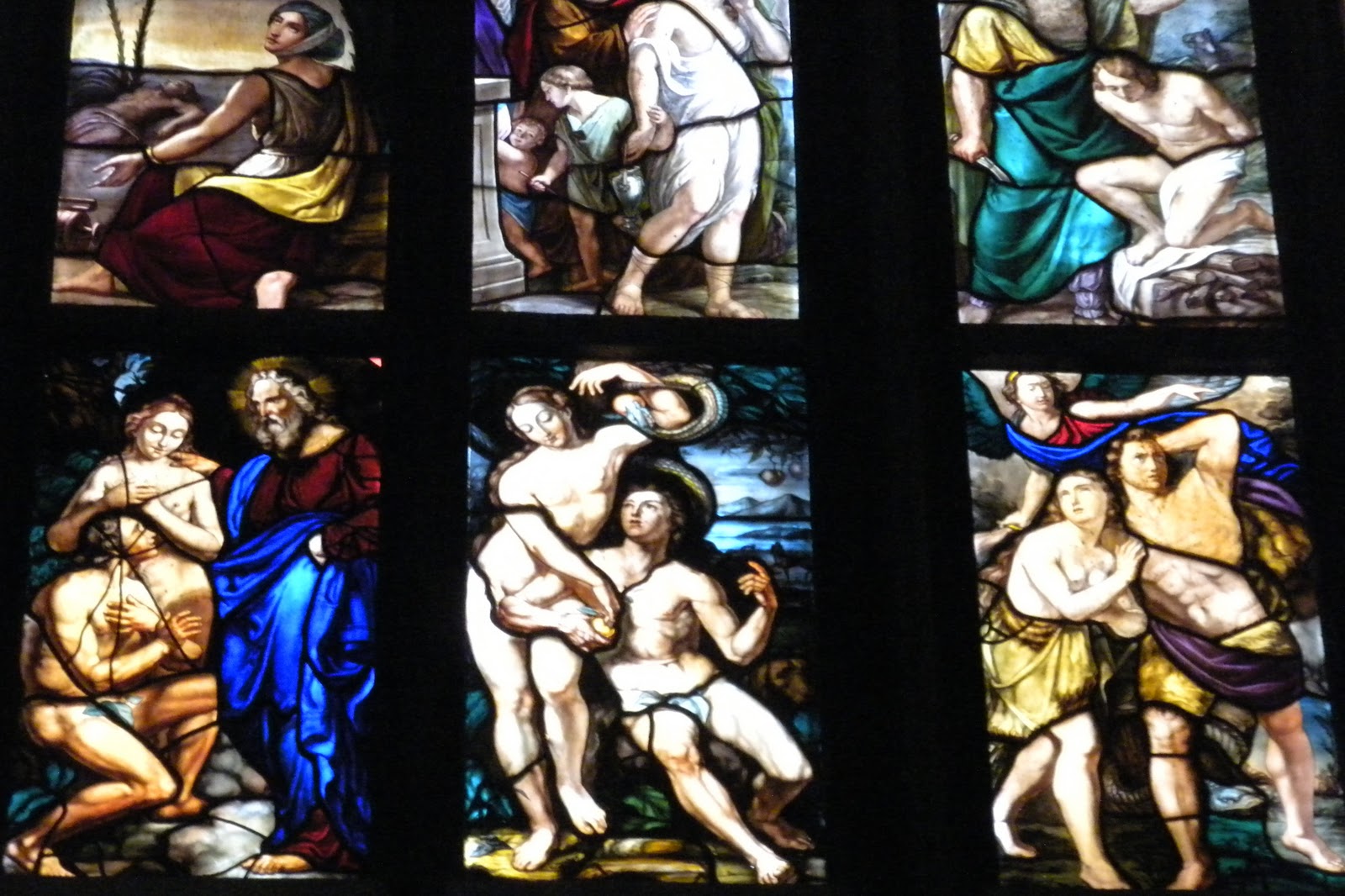
The inside was equally dramatic, with particularly high ceilings and soaring stained glass windows. Though my vote for most beautiful stained glass windows still goes to the Cathedral of St. Vitus in Prague (the Czechs have been known for their glass production for centuries), these were overwhelming in terms of size and quantity.

Scenes from the story of Adam and Eve.
With the first major site of our trip under our belts, we sought out the church of Santa Maria presso San Satiro, which was noted in the guidebook for its masterful Renaissance tromp l'oeil paintings by Bramante, the building's architect. He used the eye-misleading artwork to create the illusion of a bigger church than would have fit on the available lot. Sadly, the church did not allow photography, so I wasn't able to capture it for you.

Fading fast, we decided to try to hit one more site for the day -- the nearby Galleria Vittorio Emanuele II, a large, indoor, open-air shopping arcade. Milan is a major fashion capital, so the shopping inside was a little out of our league, but we were more interested in the building anyway. The structure consists of a two large wings that intersect in a hexagonal space, with the resulting four arms and central dome made entirely out of steel and glass. Built in the l860s, this was the first structural use of glass in an Italian building. Prior to this, glass was only a decorative element.

Inside the Galleria Vittorio Emanuele II.
The building also has some nice Neo-Classical floor mosaics, though many were under reconstruction while we were there. Most notably, however, was the depiction of a bull (all of the symbols of the zodiac were represented, and the bull is Taurus), with a swarm of tourists standing around it. Apparently, local legend holds that whoever stomps on the genitals of the bull (long worn into a deep depression in the floor) and turns around in a circle will be the recipient of good luck. We dutifully participated in the ritual as well.

(Not either of us.)
By the time we were finished there, however, we were practically falling asleep standing up, and we returned to the hotel for a little pre-dinner nap, followed by a (what would be considered outlandishly early, by Italian standards) dinner at nearby restaurant, before collapsing into a well-earned slumber on our first night in Italy.